
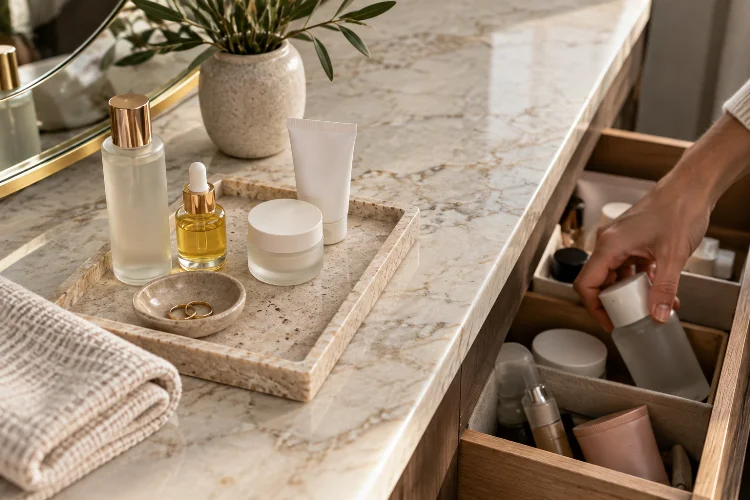
A crowded bathroom shelf can make skincare feel more advanced than it actually is. You may have three hydrating serums, two exfoliants, several masks, an eye cream, a retinoid, multiple moisturizers, and a few products you cannot quite remember buying.
The problem is not simply clutter. When too many products perform similar jobs, your routine becomes harder to follow, more expensive, and potentially more irritating.
Learning how to streamline beauty products without losing visible results means identifying which steps genuinely contribute to your goals and removing the ones that mostly create repetition.
This matters because complicated topical regimens can make consistency harder, while simplification is one strategy used to improve adherence in dermatology.
The goal is not extreme minimalism. You do not need to throw away everything except soap and sunscreen.
Instead, build a smaller routine in which every product has a clear purpose, useful evidence behind it, and a realistic place in your day.
1. Start With Your Visible Goals
Before removing anything, define what you actually want your routine to accomplish.
Maybe your priorities are smoother texture, fewer breakouts, better hydration, reduced dark spots, or prevention of premature photoaging. Problems usually start when people try to treat every possible concern at the same time.
A product should remain in your routine because it helps address one of those priorities, not because it was expensive or currently trending.
For example, if dryness is your biggest concern, moisturizer deserves more attention than three separate brightening serums.
If photoaging is your priority, sunscreen and a suitable evidence-based treatment may offer more practical value than several vaguely labeled “renewal” products.
The American Academy of Dermatology similarly recommends establishing basics such as sunscreen and moisturizer, then focusing on a primary concern instead of combining many treatment products that may increase irritation.
A streamlined routine starts with outcomes, not product categories.
2. Keep the High-Impact Foundation
Some beauty products deserve more protection during a decluttering session than others.
A gentle cleanser, appropriate moisturizer, and sunscreen usually form a useful foundation. Everything else should be evaluated around that core.
Moisturizers can support hydration and barrier function through combinations of humectants, emollients, and occlusives. Reviews of barrier care show that these ingredients can influence hydration and transepidermal water loss in different ways.
Sun protection deserves similar priority.
The AAD recommends broad-spectrum, water-resistant SPF 30 or higher when choosing sunscreen for routine sun protection.
These products may not feel as exciting as a newly launched serum, but removing foundational steps while keeping five optional treatments is usually the wrong direction.
Think of the basics as infrastructure. Fancy additions work better when the infrastructure underneath them is solid.
3. Identify Duplicate Functions
The fastest way to simplify beauty products is to look for overlap.
Suppose your routine contains a hydrating toner, hyaluronic acid serum, hydrating essence, peptide serum with glycerin, and moisturizing gel. Several of those products may primarily be helping with hydration and surface comfort.
That does not make any of them useless.
It simply means you may not need all of them.
The same problem becomes more important with active ingredients. Using an exfoliating cleanser, glycolic toner, acid serum, retinoid, and weekly peel can result in a much higher irritation load than expected.
Dermatologists warn that using too many products, particularly multiple anti-aging treatments, can irritate the skin.
Look at functions instead of labels
Marketing names can make similar formulas appear completely different.
One product might be called an “essence,” another a “booster,” and another a “skin concentrate,” even though all three mainly deliver humectants and emollients.
Read the ingredient list and the product’s intended purpose.
If two steps perform essentially the same job and you cannot identify a meaningful difference in results, keep the one that feels better, fits your budget, and is easier to use consistantly.
4. Choose One Strong Treatment for Each Major Concern
Treatment products are where routines often become unnecessarily complicated.
Instead of using several actives for the same concern, choose one strong candidate and evaluate it properly.
For photoaging, topical tretinoin provides a useful example because its benefits have been investigated in randomized trials and systematic reviews. Research has found improvements in clinical signs such as wrinkles and mottled pigmentation with long-term topical tretinoin use.
That does not mean everyone should use tretinoin, especially because prescription treatments require appropriate medical guidance and can cause irritation.
The broader principle is what matters.
Choose treatments with a clear purpose rather than accumulating several products that make similar promises.
Someone concerned primarily with pigmentation might use one targeted brightening treatment rather than four different “radiance” serums. Someone focused on acne may benefit more from a structured acne regimen than constantly rotating trendy exfoliants.
Precision usually beats volume.
5. Keep Moisturizer Even When Your Skin Looks Good
Moisturizer is sometimes the first product people remove when trying to simplify.
That can be a mistake, especially if treatment products already place stress on the skin.
Moisturizers help support the stratum corneum and can improve surface hydration. However, formulations differ, and studies show that moisturizer composition can influence barrier outcomes.
This means you do not need several moisturizers layered together every night.
You simply need one that suits your skin, environment, and routine.
Someone with oily skin in humid weather might prefer a lightweight lotion. Dry skin or frequent exposure to air conditioning may call for something richer.
A good moisturizer can also reduce your dependence on several separate hydrating products, which makes it one of the easiest ways to streamline a routine without sacrificing comfort.
6. Simplify Morning and Evening Differently
You do not need identical routines twice a day.
Morning skincare works best when it focuses on preparation and protection. That may mean cleansing when necessary, moisturizer if needed, one priority treatment, and sunscreen.
Evening skincare can focus more on removing sunscreen or makeup, applying treatments, and supporting overnight comfort.
This separation immediately reduces the temptation to use everything twice.
The AAD’s general skincare order is similarly straightforward: cleansing first, treatment products next, followed by moisturizer and/or sunscreen.
You can make the routine even easier by deciding which products belong exclusively to morning or night.
Vitamin C serum, for example, might stay in your morning category. A retinoid might belong in the evening.
Clear roles reduce both clutter and decision fatigue.
7. Remove Products Gradually, Not All at Once
If you currently use ten products, do not necessarily cut down to three overnight.
You may have difficulty figuring out which removed product was actually contributing to your results.
Instead, streamline gradually.
Remove one obviously redundant product and keep everything else stable for a reasonable period. Pay attention to hydration, breakouts, pigmentation, sensitivity, and overall comfort.
If nothing changes, that product probably was not essential.
Then evaluate the next one.
This process is slower than dumping half your shelf into a drawer, but it produces more useful information.
Taking standardized photos every few weeks can also help because visible skincare results often develop gradually.
Simplification should be an experiment, not a guessing game.
8. Make Consistency the Performance Metric
A five-step routine used regularly can outperform an eleven-step routine that you complete only when you have enough energy.
Research on dermatology adherence consistently identifies regimen complexity as one factor that can reduce how faithfully topical treatments are used.
This is particularly important because many skincare changes take weeks or months.
If a complicated routine causes you to skip skincare several nights per week, the extra products may actually reduce the practical value of the routine.
Create a minimum version for busy days.
Maybe your evening minimum is cleanser, one important treatment when appropriate, and moisturizer. Your full routine can contain an optional extra step when you have more time.
That flexibility makes long-term consistancy easier.
9. Stop Treating New Products as Automatic Upgrades
A streamlined routine can quickly become complicated again if every new launch feels like something you need.
Beauty marketing thrives on novelty. Your skin does not necessarily need novelty.
A new product should replace something, solve a clearly defined problem, or add a benefit you are genuinely missing.
Before buying it, ask what job it would perform.
If you already own two products doing essentially the same thing, the new one probably creates overlap rather than improvement.
This mindset can also help you evaluate results more accurately.
When products change every week, it becomes almost impossible to know which ingredient improved your skin or which one caused irritation.
A stable routine creates better information.
Learning how to streamline beauty products without losing visible results is really an exercise in prioritization.
Keep the fundamentals that support everyday skin function, including gentle cleansing, appropriate moisturization, and sun protection. Then choose targeted treatments based on your most important concerns while removing products that duplicate the same job.
Simplify gradually so you can see what actually matters, and judge the routine by results, comfort, cost, and how easily you can maintain it.
Open your skincare cabinet today and give every product one clear job. If two or three items are competing for the same role, start testing whether you truly need all of them.
A shorter routine does not have to mean fewer results. Done well, it can mean fewer distractions between you and the steps that actually work.