
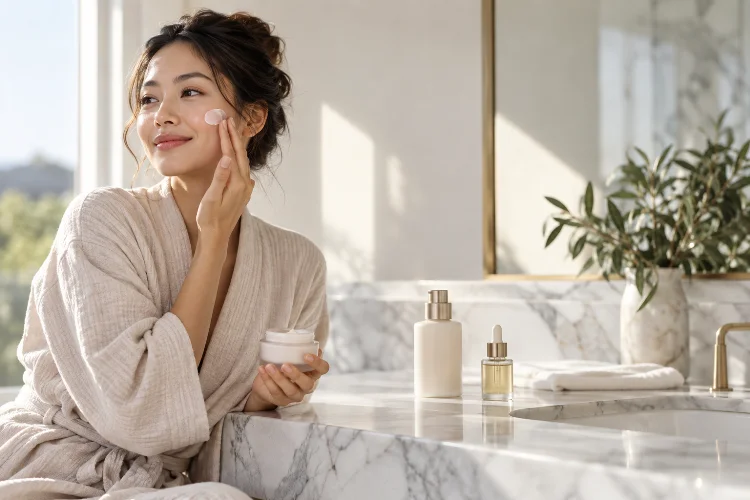
Beauty routines have a strange tendency to grow. You start with cleanser and moisturizer, add a serum for pigmentation, another for hydration, an exfoliant for texture, an eye cream, a retinoid, two masks, and suddenly getting ready for bed feels like a laboratory procedure.
More products, however, do not automatically produce better skin.
Advanced beauty routine design for maximum impact with less effort is about identifying the steps that produce the greatest practical value and making them easy enough to repeat consistently.
Dermatology research on treatment adherence shows that regimen complexity can reduce adherence, while simplifying routines can help people stick with them.
The same logic works surprisingly well for everyday beauty care.
Instead of trying to maximize the number of ingredients you use, the smarter approach is to protect the fundamentals, choose treatments around your real priorities, eliminate unnecessary overlap, and design the routine around your actual lifestyle.
1. Start With Outcomes, Not Products
A good beauty routine should begin with a question: what are you actually trying to improve?
Maybe your priorities are controlling breakouts, reducing uneven pigmentation, improving dryness, maintaining smoother texture, or preventing premature photoaging. Trying to target every possible concern at once usually leads to unnecessary complexity.
The American Academy of Dermatology recommends focusing on one primary concern after establishing foundational skincare, partly because multiple anti-aging products used together can increase irritation.
That principle makes routine design much simpler.
If pigmentation is your main concern, for example, your treatment strategy should revolve around that instead of collecting products for pores, wrinkles, brightness, exfoliation, hydration, lifting, and “detoxing” at the same time.
Give every product a job
Look at each product on your shelf and ask what it contributes.
If three serums essentially perform the same moisturizing function, you may not need all three. If two strong treatments target similar concerns, alternating or choosing one may be more practical.
Your routine should resemble a small team with clearly defined roles, not a crowded meeting where everyone is doing the same job.
2. Build Around the Highest-Impact Basics
Most efficient skincare routines have a surprisingly simple foundation: cleansing, moisturizing, and sun protection.
Gentle cleansing removes oil, sweat, sunscreen, makeup, and debris without requiring aggressive scrubbing. Dermatologists recommend a mild, non-abrasive cleanser, lukewarm water, and limiting routine face washing to around twice daily and after heavy sweating.
Moisturizer helps support hydration and skin-barrier function. Ingredients such as humectants, emollients, and occlusives work through different mechanisms to support the stratum corneum and reduce water loss.
Then there is sunscreen.
For long-term skin appearance, this is one of the highest-value steps available. The AAD describes sun protection as a foundation of anti-aging skincare and recommends broad-spectrum, water-resistant SPF 30 or higher.
These steps may look basic, but they create the platform on which everything else works.
3. Choose One High-Value Active Before Adding More
Once the foundation is stable, choose treatments based on the concern that matters most.
Retinoids provide a good example. They have substantially more research behind them for photoaging than many trendy cosmetic ingredients.
A systematic review of randomized controlled trials found topical tretinoin improved several signs of photoaging, including wrinkles and mottled pigmentation.
That does not mean everyone needs prescription tretinoin.
Over-the-counter retinoids such as retinol and retinaldehyde are also used in cosmetic skincare, although their efficacy, tolerability, and stability differ.
The important principle is prioritization.
A routine containing one carefully chosen treatment used consistantly can make more sense than five actives applied unpredictably.
Start slowly, particularly with products known to cause irritation. Increasing strength or frequency before your skin adapts rarely makes a routine more efficient.
4. Reduce Ingredient Overlap
One hidden source of routine complexity is ingredient duplication.
Imagine using an exfoliating cleanser, glycolic toner, exfoliating serum, retinol, and weekly peeling mask. Each product may look reasonable individually, but together they can create far more exfoliation and irritation than intended.
The same problem can happen with hydration.
Someone might layer toner, essence, hyaluronic acid serum, hydrating ampoule, gel moisturizer, and sleeping mask when one well-formulated moisturizer could cover much of the same function.
Using too many products can increase irritation, particularly when multiple treatment products are involved.
Instead of evaluating products one by one, evaluate the entire routine as a system.
Ask where ingredients overlap, which steps provide unique benefits, and what you could remove without meaningfully changing the outcome.
Sometimes subtraction is the biggest upgrade.
5. Design Separate Morning and Evening Priorities
Your morning and evening routines do not need to perform identical jobs.
Morning skincare can focus on preparation and protection. A practical structure might involve gentle cleansing when necessary, moisturizer, and sunscreen. An antioxidant treatment may be added if it serves a specific goal.
Evening skincare can focus more on cleansing, treatment, and recovery.
That is often a better place for retinoids and certain other treatment products, depending on their directions and your individual routine.
Keeping these roles seperate also reduces decision fatigue.
Instead of wondering which seven products to layer each morning, you know what the purpose of that routine is: protect the skin for the day ahead.
At night, the purpose shifts toward removing the day’s buildup, applying your priority treatment, and maintaining comfortable hydration.
6. Use Product Pairing to Reduce Steps
Efficiency improves when one product performs multiple useful functions without sacrificing performance.
A moisturizer that provides adequate hydration while supporting the skin barrier, for example, may eliminate the need for several separate hydrating serums.
Similarly, the AAD notes that dual-function products such as moisturizers containing appropriate sunscreen can simplify skincare, provided the sunscreen offers broad-spectrum SPF 30 or higher and is used appropriately.
Multifunctional does not mean you should buy products claiming twenty benefits.
The goal is sensible consolidation.
If one formula genuinely performs two jobs that you previously needed two products to accomplish, the routine becomes faster and easier to maintain.
This is particularly valuable during busy mornings, travel, or periods when your motivation is lower than usual.
7. Build a Routine for Bad Days, Not Just Motivated Days
The best beauty routine is not the one you can complete when you have unlimited time.
It is the one you can still manage after a long day when you would rather go directly to bed.
Research in dermatology repeatedly identifies treatment complexity as one factor influencing adherence.
That makes convenience part of performance.
If your normal nighttime routine contains nine steps but you regularly skip all of them because it feels exhausting, a three-step routine completed almost every night is likely more useful.
Create a “minimum routine” for busy days.
That might simply mean cleansing, applying the treatment that matters most when appropriate, and moisturizing. Your full routine can remain available when you have more time.
Consistency does not require perfection.
8. Stop Changing Products Before They Have Time to Work
Constant experimentation creates another form of unnecessary effort.
You buy a serum, use it for nine days, decide nothing is happening, replace it, then repeat the cycle with another trending formula.
Many skincare results simply do not appear that quickly.
The AAD notes that while moisturizers can create visible improvements relatively quickly, many anti-aging products need at least several weeks, and sometimes months, before meaningful results become apparent.
Switching constantly also makes it difficult to identify what actually helped—or caused irritation.
Choose products intentionally and give them a realistic evaluation period.
Taking a simple photo under similar lighting every few weeks can be more useful than inspecting your face from five centimeters away every morning.
Progress is often gradual enough that daily observation makes it difficult to notice.
Advanced beauty routine design is not about discovering the perfect ten-step sequence. It is about directing your time, products, and attention toward the steps that offer the most meaningful return.
Start with gentle cleansing, moisturization, and reliable sun protection. Add treatments according to your biggest concern, reduce duplicated ingredients, and use multifunctional products when they genuinely simplify the routine.
Most importantly, design your routine around what you can repeat regularily. A theoretically perfect regimen has limited value if it is too complicated to maintain.
Take ten minutes today to audit your current products. Identify what each one actually does, remove obvious overlap, and decide which few steps deserve priority.
A smarter routine should give your skin more consistency while asking considerably less from your schedule.