
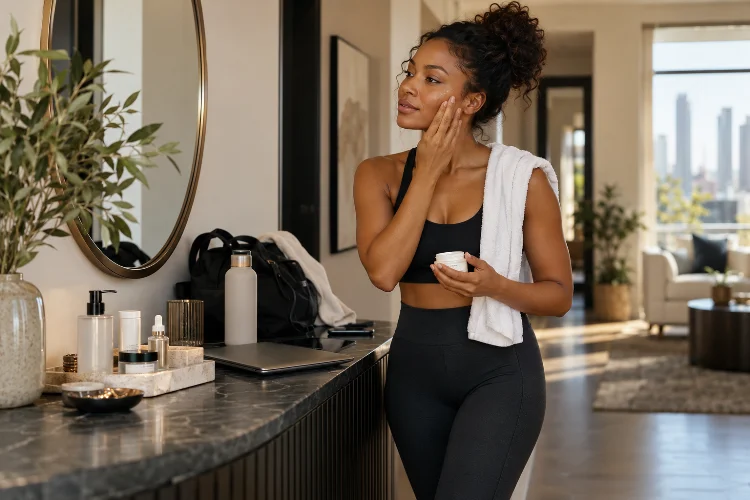
A beauty routine can look amazing on paper and still fail completely in real life.
Maybe it requires eight products before work, but you normally have twelve minutes to get ready. Perhaps your retinoid schedule makes sense until you travel, work late, exercise more often, or spend several days outdoors.
The problem is not necessarily the products. The routine simply does not fit the person using it.
That is why building a high-performance beauty routine around your lifestyle is more useful than copying someone else’s ten-step regimen.
A high-performing routine should address your real skin priorities while fitting naturally into your schedule, environment, budget, and tolerance.
Consistency matters here. Research on dermatological treatment adherence shows that regimen complexity can influence whether people actually follow topical treatments over time.
The goal is therefore not maximum skincare. It is maximum useful impact from a routine simple and flexible enough to survive ordinary life.
1. Design Around Your Real Day, Not Your Ideal Day
Before choosing products, look at what your normal week actually looks like.
Do you wake up early? Work night shifts? Exercise before work? Spend hours outdoors? Travel regularly? Wear makeup most days? These details influence what kind of beauty routine is realistic.
For someone who leaves home at 6 a.m., a complicated seven-layer morning routine may eventually become a skipped routine. A person working from home, meanwhile, may have more flexibility but still need reliable sunscreen when spending time outdoors.
This is where efficiency becomes part of performance.
Dermatology research repeatedly identifies treatment complexity as a factor affecting adherence. Simplifying a regimen can therefore have practical value, especially when topical steps must be repeated for months rather than several days.
Build for the version of yourself who is tired, busy, and occasionally unmotivated – not only the highly organized version who has thirty spare minutes every morning.
2. Establish a Small Non-Negotiable Core
A lifestyle-friendly routine becomes much easier when a few steps remain relatively stable.
For most people, that core revolves around cleansing when needed, moisturizing according to skin type, and protecting exposed skin from ultraviolet radiation.
The American Academy of Dermatology recommends gentle cleansing rather than aggressive scrubbing and emphasizes consistent moisturizer and sun protection as basic components of skincare.
It has also noted that consistency with fewer products can be more useful than maintaining an unnecessarily elaborate routine.
Think of this as your minimum viable routine
Your full routine might contain five products.
Your minimum version could contain three.
That distinction is useful when traveling, working late, caring for children, recovering from illness, or simply having a very busy week.
Instead of abandoning skincare completely because you cannot complete the “perfect” routine, you still maintain the steps with the highest everyday value.
3. Match Treatment Products to Your Biggest Priority
Once the foundation is established, decide what your treatment products are supposed to achieve.
Do not start with ingredient names. Start with outcomes.
If your primary concern is acne, your treatment strategy should reflect acne. If pigmentation bothers you most, choose products designed around pigmentation.
If your priority is photoaging, sun protection and an appropriate evidence-based treatment deserve more attention than unrelated trendy serums.
The AAD similarly recommends focusing on a primary aging concern rather than stacking many treatment products at once, because multiple products can increase irritation.
This keeps your routine targeted.
Imagine someone using six serums but unable to explain what three of them do. That is usually a sign the routine grew through shopping rather than deliberate design.
Every recurring step should have a clear reason to stay.
4. Let Your Environment Change the Routine
High-performance routines should be adjustable.
The moisturizer that feels perfect during a humid summer may feel inadequate after several days in an air-conditioned hotel. A rich cream that works beautifully during colder weather might become uncomfortable during a hot, sweaty week.
Outdoor exposure matters too.
UV protection has strong evidence behind it. In a randomized trial, regular sunscreen use was associated with less skin aging compared with discretionary use.
The AAD recommends broad-spectrum SPF 30 or higher and advises reapplication during extended outdoor exposure.
Someone who spends most of the week commuting between indoor spaces may therefore need a different practical sunscreen strategy from someone hiking, working outdoors, or spending a weekend at the beach.
Your environment is part of your skincare routine even though it does not come in a bottle.
5. Schedule Stronger Actives Around Recovery
Active ingredients should fit your skin’s recovery capacity as well as your calendar.
Suppose you use a retinoid but know that Thursday evenings include a long workout followed by shaving. You may discover that using your strongest treatment on Wednesday night increases irritation.
Moving that treatment to another evening may solve the problem without buying anything new.
The same logic applies to exfoliating acids and other potentially irritating products.
Avoid treating frequency as a competition. Using something seven nights per week is not automatically superior to three nights if the higher frequency leaves your skin continuously irritated.
The AAD warns that using several treatment products together can increase irritation, and product order also influences how a routine functions.
A practical schedule might include treatment nights and simpler recovery nights consisting mainly of gentle cleansing and moisturizer.
This gives the routine structure without making it rigid.
6. Make Morning Skincare Fast and Protective
Morning routines usually work better when they are designed around preparation and protection.
You may need only a few steps: cleanse or rinse when appropriate, apply your priority morning treatment if you use one, moisturize when necessary, and finish with sunscreen.
One product can occasionally perform more than one job.
For example, a moisturizer with appropriate broad-spectrum sunscreen can reduce steps for someone whose skin and daily exposure make that format suitable.
The AAD notes that moisturizer with sunscreen is acceptable when it provides broad-spectrum SPF 30 or higher.
Convenience should not mean careless application, however.
A multifunctional formula saves effort only when you use enough of it to perform its intended function.
The goal is fewer meaningful steps, not fewer effective ones.
7. Use Your Evening Routine for Treatment and Reset
Evening skincare has a different job.
This is when sunscreen, makeup, excess oil, and the day’s buildup usually need to be removed. It is also a convenient time for treatments that do not fit easily into the morning.
A straightforward sequence is generally cleanser, treatment, and moisturizer, adjusted according to product instructions.
The AAD recommends applying treatment products after cleansing and then moisturizer or sunscreen as appropriate.
Keeping the sequence predictable reduces decision fatigue.
Store frequently used products where the routine happens rather than hiding them in a cupboard across the room. Small behavioral details like this can make consistancy easier.
You can also pair skincare with an existing habit. Washing your face immediately after brushing your teeth, for example, creates a simple behavioral cue.
A high-performance beauty routine is partly about cosmetic science and partly about good habit design.
8. Create Special Versions for Travel, Exercise, and Busy Weeks
Trying to force one identical routine into every situation creates unnecessary friction.
Instead, create variations.
Your travel routine might use a gentle cleanser, one treatment, moisturizer, and sunscreen. Your post-workout routine might prioritize removing sweat and reapplying appropriate protection. During an extremely busy week, you might temporarily rely on your minimum routine.
This flexibility does not mean being inconsistant.
It means protecting the purpose of the routine when circumstances change.
The principle is similar to adherence strategies in dermatology: treatments need to be manageable enough that people actually continue using them. Recent research has found complex topical regimens among factors associated with lower adherence.
A slightly simpler routine maintained for a year can have more practical value than an elaborate routine abandoned after three weeks.
9. Measure Results Instead of Constantly Shopping
One final habit can dramatically improve routine efficiency: stop changing products too quickly.
Beauty marketing encourages constant experimentation. New serum, new cleanser, new ingredient, new problem to solve.
That makes it almost impossible to understand what is actually working.
Instead, establish a stable baseline and periodically review your skin under similar conditions. Photos taken every few weeks in similar lighting can make gradual changes easier to notice.
Also assess comfort.
Is your skin becoming less dry? Are breakouts improving? Does your sunscreen fit naturally into your morning? Are you constantly irritated? Can you follow the routine without thinking about it?
Performance is not simply how sophisticated the ingredient list looks.
A routine is performing well when it produces useful results without requiring unreasonable effort, cost, or maintainance.
Building a high-performance beauty routine around your lifestyle means designing skincare for the life you actually live.
Start with a dependable core of gentle cleansing, appropriate moisturization, and sun protection. Add treatments according to your highest-priority concern, then adjust their timing around work, exercise, travel, climate, and your skin’s tolerance.
Most importantly, make the routine easy enough to repeat regularily.
Before buying another product, review what you already use. Give every step a clear job, remove unnecessary duplication, and create a minimum routine for hectic days.
The most sophisticated routine is not necessarily the longest one. It is the routine that combines evidence, personal needs, and realistic habits so effectively that taking care of your skin becomes an easy part of everyday life.