
When hair starts feeling weaker, duller, or harder to manage, most people immediately look at the ends. They buy richer conditioners, repair masks, oils, or another serum designed to make damaged strands look smoother.
But part of the story starts much closer to the root.
The scalp has its own protective barrier, built largely around the stratum corneum, lipids, water balance, microorganisms, and immune activity. This barrier helps reduce unnecessary water loss while limiting exposure to irritants and environmental stressors.
Research on dandruff has shown that compromised scalp barrier function can involve elevated transepidermal water loss, altered lipids, and greater sensitivity to irritation.
Understanding how scalp barrier function influences long-term hair condition does not mean claiming that moisturized scalp skin automatically makes every strand thicker.
Instead, a healthier scalp creates a more comfortable environment around hair follicles, while good hair-care habits protect the fiber after it grows out.
1. The Scalp Barrier Works Much Like Other Skin Barriers
The scalp may be covered with hair, but biologically it is still skin.
Its outermost layer helps control water loss and provides a physical defense against chemicals, microorganisms, pollutants, and other potential irritants.
Lipids such as ceramides, cholesterol, and fatty acids contribute to that protective structure.
Research comparing dandruff and healthy scalps has found reduced levels of several intercellular lipids in dandruff, alongside signs of impaired barrier quality.
That is useful because it changes how we think about scalp health.
Persistent itching, tightness, or flaking should not always be treated as a simple cosmetic inconvenience. Those symptoms may reflect disruption in a system responsible for maintaining hydration and protecting the underlying skin.
A healthy barrier does not need to feel heavily moisturized.
It needs to function well.
2. Water Loss Can Make the Scalp More Reactive
One way researchers assess barrier function is transepidermal water loss, often shortened to TEWL.
TEWL describes water moving from inside the body through the epidermis and into the surrounding environment. Some water loss is normal, but elevated levels can indicate a less efficient barrier.
Dandruff research has found increased TEWL alongside disorganized structural lipids and subclinical inflammation.
That can help explain why a compromised scalp may feel itchy, dry, tight, or unusually reactive to products.
The solution is not necessarily to pour oil over the scalp.
If the underlying issue involves dandruff, seborrheic dermatitis, contact irritation, or another inflammatory condition, simply adding an occlusive product may not address the cause.
Barrier support works best when you understand what is disrupting the barrier in the first place.
3. Dandruff Is More Than “Dry Skin”
One of the most common scalp misconceptions is assuming every flake means dryness.
Dandruff is more complicated.
Research describes it as a multifactorial condition involving sebum, individual susceptibility, microorganisms such as Malassezia, barrier dysfunction, and inflammatory responses.
Microbiome studies also show differences between healthy and dandruff-affected scalps. A systematic review found associations between certain microbial patterns, increased TEWL, changes in scalp pH, itching, and disease severity.
This is why scalp oil alone is not a universal dandruff treatment.
The American Academy of Dermatology recommends medicated shampoos containing ingredients such as ketoconazole, selenium sulfide, salicylic acid, sulfur, zinc pyrithione, or coal tar, depending on the product and individual needs.
Treat the condition rather than simply covering the flakes.
4. The Scalp Microbiome and Barrier Influence Each Other
Your scalp is home to communities of bacteria and fungi.
These organisms are normal parts of the skin environment, and the goal is not to remove every microbe.
Recent reviews describe the scalp microbiome as part of scalp homeostasis, with microbial imbalance associated with conditions including dandruff, seborrheic dermatitis, psoriasis, alopecia areata, and folliculitis.
Barrier function and microbial balance also appear to interact.
A disrupted barrier may change the local environment in ways that favor inflammation or microbial shifts, while microbial metabolites may further irritate susceptible skin.
This creates a potential cycle: irritation weakens barrier performance, and worsening barrier conditions contribute to further irritation.
That does not mean you need a “microbiome detox.”
For most people, keeping the scalp clean, treating real scalp conditions, and avoiding constant irritation is a much more useful strategy than chasing probiotic hair products.
5. Wash Often Enough to Control Oil and Buildup
Fear of “stripping the scalp” can sometimes lead people to avoid shampoo for too long.
That is not automatically barrier-friendly.
Sebum, sweat, dead skin, styling residue, and environmental debris accumulate over time. For people prone to dandruff or an oily scalp, inadequate cleansing can make the scalp feel increasingly uncomfortable.
The AAD recommends washing according to how quickly the scalp becomes dirty or oily. Fine, straight hair with an oily scalp may need frequent washing, while dry, curly, coarse, or coily hair often benefits from less frequent shampooing.
Put shampoo where it is actually needed
Focus shampoo primarily on the scalp.
This removes oil and buildup without unnecessarily stripping the entire length of older hair fibers.
A scalp-care routine should therefore be personalized rather than based on a rule like “never shampoo daily.”
The correct frequency is the one that keeps your scalp comfortable without creating persistent dryness or irritation.
6. Do Not Confuse Scalp Health With Hair-Shaft Repair
This distinction is essential.
Hair fibers that have already grown out are largely made of keratinized tissue. They cannot biologically heal themselves in the same way living skin does.
Conditioners and repair products can still be extremely useful.
They can smooth cuticle surfaces, reduce friction, improve detangling, enhance shine, and help limit breakage.
Research on hair cosmetics describes conditioners as useful for reducing fiber friction and improving manageability, while chemical processing and inappropriate grooming can damage the hair shaft.
But that is different from scalp barrier repair.
Think of the system as two connected jobs:
The scalp needs cleansing, comfortable barrier function, and management of inflammation.
The hair length needs protection from friction, heat, chemicals, and mechanical damage.
Treating those jobs seperately usually creates a smarter routine.
7. Product Buildup Can Become a Scalp Problem
More scalp products do not necessarily create a healthier scalp.
Leave-in conditioners, oils, dry shampoos, styling waxes, sprays, and scalp serums can accumulate, particularly when applied close to the roots.
The AAD advises applying leave-in conditioner primarily to the hair rather than the scalp because scalp application can contribute to buildup and irritation.
That does not make leave-in products bad.
Placement matters.
Use conditioning products where the hair actually needs them – often through the mid-lengths and ends – while keeping scalp treatments limited to products designed for the underlying scalp concern.
If the scalp constantly feels coated, itchy, or heavy, adding another serum may be the opposite of what it needs.
Sometimes better cleansing is the solution.
8. Reduce Irritation From Heat, Chemicals, and Friction
Barrier health can also be affected by what happens during styling.
Hair dyes, straightening products, fragranced formulations, preservatives, and other cosmetic ingredients may irritate susceptible scalps.
Hair-care research also documents the potential for some cosmetic procedures to contribute to contact dermatitis, follicular stress, and fiber damage.
Mechanical habits matter too.
Aggressive scratching, rough brushing at the roots, very tight hairstyles, and repeatedly pulling the scalp can create unnecessary stress.
For the hair shaft, excessive heat and rough treatment increase damage and breakage. The AAD recommends gentle handling, careful detangling, and limiting high heat.
Long-term scalp and hair maintanance is therefore partly about removing repeated low-level damage.
You do not always need another treatment.
Sometimes you need fewer stressors.
9. A Healthy Scalp Cannot Override Every Cause of Hair Loss
Good barrier care supports scalp comfort, but it should not be marketed as a cure for every type of thinning.
Hair loss can result from genetic pattern loss, alopecia areata, telogen effluvium, inflammatory scalp disease, nutrient deficiencies, infections, medication effects, hormonal issues, traction, and scarring alopecia.
Those problems require different approaches.
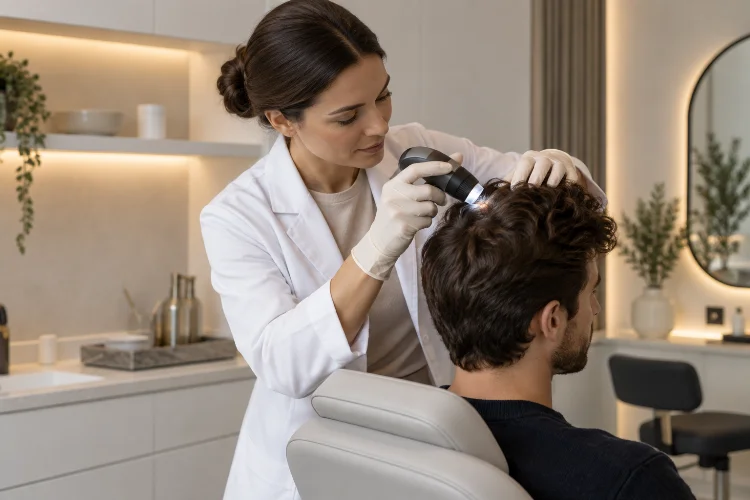
Dermatologists may examine the scalp and hair, review the medical history, perform a hair-pull assessment, order blood tests, or use a scalp biopsy depending on the suspected cause.
This distinction protects you from spending months trying new shampoos when the actual problem needs medical diagnosis.
Scalp care supports the environment.
It does not override genetics, hormones, autoimmune disease, or permanent follicular damage.
10. Build a Routine Around Scalp Signals
The best scalp routine does not need ten steps.
Start by noticing what your scalp actually does.
Does it become oily within a day? Does it itch after several days without shampoo? Are flakes greasy or powdery? Does a new product cause burning? Do symptoms worsen after coloring or chemical treatments?
Those patterns tell you far more than generic social-media routines.
A practical routine might consist of appropriate shampooing, targeted dandruff treatment when needed, conditioner focused mainly on the hair length, and fewer unnecessary products at the roots.
Keep changes consistantly simple enough that you can tell what improves or worsens the situation.
If persistent itching, redness, painful bumps, thick scale, sudden shedding, or visible thinning develops, seek professional evaluation.
Scalp barrier care works best as prevention and sensible maintanance – not as a reason to ignore symptoms that need diagnosis.
Scalp barrier function can influence long-term hair condition by shaping the environment surrounding the follicles and determining how comfortably the scalp handles water loss, sebum, microorganisms, products, and external stress.
A healthier barrier does not guarantee thicker hair, and scalp treatments cannot repair already damaged hair fibers. Those are related but seperate problems.
For long-term results, clean the scalp according to its needs, manage dandruff appropriately, avoid chronic irritation and unnecessary buildup, and protect the hair lengths with conditioning and gentle styling.
Start by evaluating your scalp rather than buying another hair-growth product. If it is constantly itchy, flaky, oily, or irritated, address that environment first.
A calmer scalp and better-protected hair fiber make a much stronger foundation for maintaining healthy-looking hair over time.