
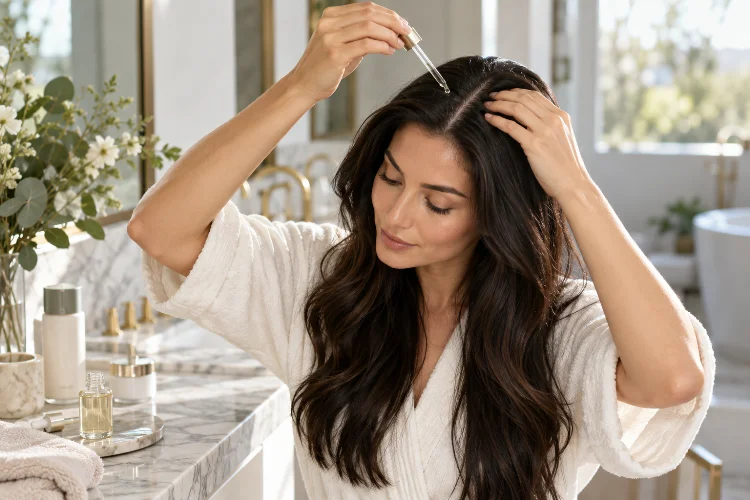
Great hair care usually starts several centimeters before the visible hair itself – with the scalp.
It is easy to focus entirely on conditioners, masks, oils, and styling products because those are the things that make hair immediately look smoother.
But the scalp contains the follicles responsible for producing new hair, along with sebaceous glands, immune structures, microorganisms, and a skin barrier that can become irritated or inflamed.
That is why advanced scalp health strategies for stronger hair quality should address two different goals at once: maintaining a comfortable environment around the follicles and protecting the hair fiber after it emerges.
Research increasingly describes the scalp as a complex ecosystem where microorganisms, sebum, barrier function, and inflammation interact.
Disruptions are associated with conditions such as dandruff and seborrheic dermatitis, although microbiome science is still developing.
Healthy scalp care is therefore not about aggressively “detoxing” follicles. It is about creating a routine that cleans effectively, limits unnecessary irritation, and protects the hair you already have.
1. Match Cleansing Frequency to Your Scalp
There is no universal rule saying everyone should shampoo daily – or avoid daily shampooing.
Your ideal frequency depends on oil production, hair texture, physical activity, styling products, climate, and scalp conditions.
Someone with fine straight hair and an oily scalp may need relatively frequent cleansing. A person with coarse, curly, or tightly coiled hair may wash less often because the lengths tend to be drier.
The American Academy of Dermatology recommends washing based on how quickly the scalp and hair become dirty or oily. It also advises applying shampoo primarily to the scalp rather than aggressively rubbing shampoo through the entire length.
That distinction is useful.
The scalp needs cleansing, while the older hair at the ends usually needs more protection from unnecessary stripping.
A good wash should leave the scalp comfortable – not painfully tight, itchy, or coated in heavy residue.
2. Treat Dandruff Instead of Trying to Moisturize It Away
Flakes do not automatically mean the scalp is simply “too dry.”
Dandruff and seborrheic dermatitis can involve sebum, inflammation, barrier changes, and microorganisms such as Malassezia.
Research has also found differences in bacterial and fungal communities between healthy scalps and scalps affected by dandruff or seborrheic dermatitis.
That means repeatedly applying oils may not address the underlying problem and can sometimes make an oily scalp feel even heavier.
The AAD recommends medicated dandruff shampoos containing active ingredients such as ketoconazole, selenium sulfide, salicylic acid, sulfur, zinc pyrithione, or coal tar, depending on product availability and individual needs.
Some formulas need several minutes of contact with the scalp before rinsing.
Dry scalp and dandruff are not always the same
A genuinely dry scalp may improve with a gentler shampoo and less irritation.
Persistent greasy scaling, redness, significant itching, or recurring thick flakes may point toward dandruff, seborrheic dermatitis, psoriasis, eczema, or another condition instead.
Correct diagnosis matters more than buying another scalp oil.
3. Stop Treating the Scalp Microbiome Like Something to “Reset”
Scalp microbiome marketing has become increasingly popular.
The biology behind it is real: bacteria and fungi naturally live on the scalp and participate in interactions involving barrier function and immunity.
Reviews have identified microbial differences in conditions including dandruff, seborrheic dermatitis, alopecia areata, psoriasis, and folliculitis.
However, that does not mean you need an expensive microbiome serum.
The research is still developing, and there is no universal ideal microbial profile that consumers should try to manufacture at home.
A more practical strategy is maintaining a scalp environment that does not encourage chronic irritation.
Clean according to your needs, manage diagnosed scalp conditions appropriately, rinse products thoroughly, and avoid constantly experimenting with harsh chemicals.
Microbiome health is more complicated than adding “good bacteria” to a shampoo.
4. Keep Conditioner Focused on Hair Fiber Protection
Scalp health and hair-fiber health overlap, but they are not identical.
Once a hair shaft emerges from the follicle, it cannot biologically repair itself like living skin. Cosmetic products instead help reduce friction, improve manageability, coat damaged areas, and limit additional physical damage.
Conditioner is particularly useful here.
The AAD recommends conditioning after washing because conditioner improves moisture and detangling. For finer or straighter hair, it can be concentrated toward the ends, while dry or curly hair may benefit from conditioning more of the length.
Think of shampoo and conditioner as having seperate primary jobs.
Shampoo mainly manages cleansing at the scalp. Conditioner mainly improves the condition and manageability of the fiber.
Using each product where it contributes the most can produce better results than covering everything with everything.
5. Reduce Mechanical Damage Before Buying Growth Products
Sometimes “weak hair” is simply repeatedly damaged hair.
Rough towel drying, forceful detangling, high heat, chemical straightening, bleaching, and tight hairstyles can all increase fiber damage or breakage.
Dermatologists advise handling wet hair carefully because it can be particularly vulnerable to mechanical stress. A wide-tooth comb, gentler detangling, and less aggressive towel drying can reduce unnecessary damage.
Excessive heat matters too.
Lower or medium heat settings and fewer passes with flat irons or curling tools can help preserve the hair shaft.
Tension is especially important around the follicle. Tight braids, extensions, weaves, or other continuously pulling hairstyles can contribute to hair loss in susceptible people. The AAD recommends reducing tension as part of gentle scalp and hair care.
Stronger-looking hair often starts with simply breaking less of it.
6. Be Skeptical of Scalp Oils as Universal Growth Treatments
Scalp oiling can feel relaxing, and certain oils may help condition dry hair.
But “natural” does not automatically mean appropriate for every scalp.
A person with a dry, comfortable scalp may tolerate an oil perfectly well. Someone dealing with dandruff, folliculitis, irritation, or heavy product buildup may have a very different experience.
The same skepticism should apply to claims that a topical oil can dramatically accelerate hair growth.
Hair growth is influenced by genetics, hormones, age, nutritional status, medical conditions, medications, inflammation, and the hair-growth cycle. A cosmetic oil cannot override all of those factors.
Treat oil as a grooming product unless strong clinical evidence supports a specific therapeutic claim.
That mindset can prevent the common cycle of adding more and more products to an already irritated scalp.
7. Support Hair Growth With Adequate Nutrition – Not Mega-Doses
Hair follicles require nutrients because they produce rapidly growing tissue.
Inadequate protein or deficiencies in certain nutrients can contribute to hair shedding or poor hair health. However, the solution is not automatically a handful of hair supplements.
The AAD warns that consuming too little protein, iron, or other important nutrients can contribute to hair loss. It also cautions that excessive intake of some supplements—including selenium and vitamins A and E—can worsen hair loss.
Research continues to investigate nutrients such as vitamin D, iron, and zinc in different types of alopecia, but associations do not prove that supplementation helps someone whose levels are already adequate.
Focus first on adequate calories, protein, vegetables, fruits, whole grains, healthy fats, and varied nutrient sources.
If unexplained shedding is significant, testing for an actual deficiency makes more sense than supplementing blindly.
More vitamins do not neccessarily equal more hair.
8. Protect the Scalp From Environmental Stress
The scalp is skin, which means environmental exposure still matters.
A densely covered scalp receives some natural protection from hair, but areas with thinning hair, wide parts, or shaved styles can receive substantial ultraviolet exposure.
The AAD recommends protecting exposed scalp with shade, hats, or broad-spectrum SPF 30 or higher when appropriate. This becomes especially relevant when certain treatments, such as coal-tar dandruff products, increase sun sensitivity.
Sweating can also change scalp-care needs.
If workouts leave your scalp oily, salty, or uncomfortable, adjusting cleansing frequency may be more useful than sticking rigidly to a preset wash schedule.
Climate matters too. Hot, humid weather and cold, low-humidity conditions can create very different scalp-care requirements.
Advanced care should be adaptable rather than consistantly identical.
9. Avoid Constant Scalp Scrubbing and “Detoxing”
A scalp scrub can feel satisfying, particularly when styling products have accumulated.
But physical exfoliation is not automatically required for healthy follicles.
Aggressive scratching or frequent abrasive scrubbing can irritate skin that is already inflamed. Strong acids, essential oils, or multiple exfoliating products can create similar problems when used excessively.
Remember that ordinary shampoo already removes oils, dead skin, sweat, and many styling residues.
If heavy buildup remains an issue, occasional clarifying may be enough depending on your hair type and products.
Persistent scale should be treated according to its cause rather than repeatedly scraped away.
The scalp does not need to feel stripped to be clean.
10. Know When the Problem Is More Than Hair Care
No shampoo routine can solve every type of hair loss.
Genetic pattern hair loss, alopecia areata, telogen effluvium, fungal infection, scarring alopecia, thyroid disease, nutrient deficiencies, medication effects, and other conditions can all produce shedding or thinning.
Dermatologists use scalp examination, hair assessment, medical history, blood tests, and sometimes scalp biopsy to distinguish among these causes.
Seek professional evaluation if you notice rapid shedding, bald patches, progressive thinning, scalp pain, pustules, significant redness, scarring, or persistent itching and scaling that does not improve.
Timing can matter particularly with inflammatory or scarring hair-loss disorders because permanent follicle damage may occur.
Do not spend six months changing shampoos when the real issue needs diagnosis.
Advanced scalp health strategies for stronger hair quality start by separating follicle health from hair-fiber care.
Clean the scalp according to its actual oil and buildup levels, treat dandruff appropriately, limit chronic irritation, and avoid excessive tension.
Protect the lengths with conditioner, gentle detangling, and sensible heat use while supporting normal hair growth through adequate nutrition.
Most importantly, resist the idea that every scalp needs more products.
Start by reviewing what yours is telling you. If it feels comfortable and stays relatively clear, maintain that environment. If itching, flaking, pain, or unexpected shedding persists, investigate the cause instead of continually layering treatments.
Healthy-looking hair usually comes from a combination of a well-managed scalp, protected fibers, and consistant habits – not one miracle growth product.