
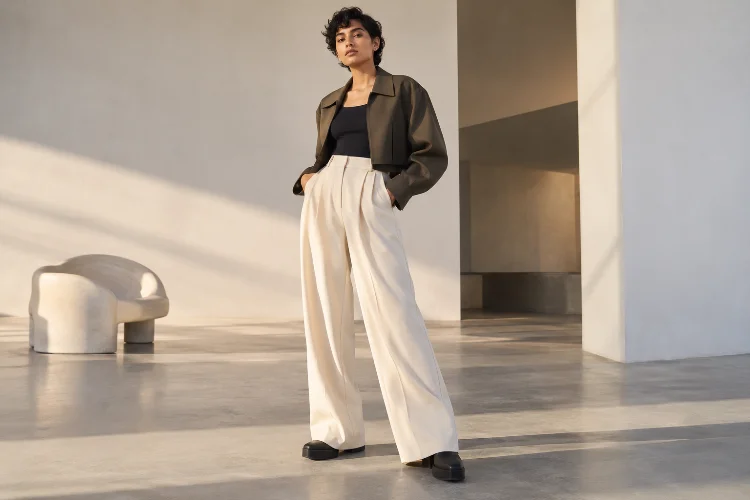
A great outfit is not always built from expensive clothes or the newest fashion trend. Sometimes the difference between an outfit that feels “almost right” and one that looks completely intentional comes down to proportion.
The length of a jacket, width of a trouser leg, position of a waistband, volume of a sleeve, or visual weight of a shoe can change how the entire outfit reads.
That is where advanced style analysis for proportion, balance, and silhouette becomes useful. Instead of relying on rigid body-type rules, it looks at relationships between garments, the body, and the overall visual composition.
Fit matters too. Research involving 502 fashion consumers found meaningful links between clothing fit, self-evaluation, confident clothing decisions, and psychological responses.
The goal is not to make every body conform to one ideal shape. It is to understand how clothing creates visual lines, emphasis, volume, and contrast so you can deliberately build the image you want.
1. Understand Proportion as a Relationship
Proportion is not simply about whether a garment is long or short.
It describes how one part of an outfit relates to another.
Imagine a long oversized blazer worn with equally wide trousers and chunky shoes. Every individual item might be stylish, but the overall composition can feel visually heavy.
Now shorten the jacket or introduce a more fitted top underneath. Suddenly, there is clearer separation between different areas of the outfit.
This is proportion at work.
You can analyze an outfit through several relationships: torso to leg length, fitted areas to loose areas, garment length to body height, and small details to larger clothing shapes.
There is no universal perfect ratio.
What matters is creating enough contrast and structure that the eye can understand the outfit easily.
2. Learn Where Clothing Creates Visual Breaks
Every garment creates visual boundaries.
A waistband creates a horizontal division. A jacket hem creates another. Boots can visually divide the lower leg, while cropped trousers create space between fabric and footwear.
These breaks influence perceived proportion.
For example, a high-rise trouser can visually shift the waist upward and change the apparent relationship between torso and legs. A long untucked shirt may do the opposite by extending the visual torso.
Neither is automatically better.
The question is what result you want.
If an outfit feels slightly unbalanced, study where the horizontal breaks occur before changing everything.
Sometimes moving a shirt tuck, adjusting a sleeve, or changing jacket length can solve the problem without replacing a single garment.
3. Use Silhouette as the Outfit’s Big Picture
Silhouette is the overall shape an outfit creates before you notice individual details.
Stand several meters away from a mirror or look at a slightly blurred photograph of your outfit. You may stop noticing buttons, patterns, and accessories and begin seeing the larger shape.
That shape might be narrow and straight, relaxed and rectangular, fitted through the waist, oversized at the top, or wide through the lower half.
This is useful because people often shop item by item while styling happens silhouette by silhouette.
A wide-leg trouser may look excellent in isolation, but its success depends partly on what happens above and below it.
A fitted top might create strong contrast. A cropped jacket might emphasize leg length. An oversized sweater could produce an intentionally relaxed column.
Build the big shape first, then refine the details.
4. Think in Terms of Visual Weight
Balance does not necessarily mean symmetry.
It means distributing visual attention so one part of the outfit does not unintentionally overpower everything else.
Several things can create visual weight: dark colors, bright colors, large prints, heavy fabrics, oversized shapes, dramatic accessories, and substantial footwear.
Imagine wearing slim black trousers with an enormous puffer jacket and very delicate shoes.
The upper body may visually dominate because the jacket carries far more volume and weight than the rest of the outfit.
You could restore balence by using stronger footwear, slightly wider trousers, or reducing the jacket volume.
This principle also works with accessories.
A very large bag paired with extremely delicate clothing changes the composition differently than a compact structured bag would.
Analyze the outfit as a whole rather than judging every item seperately.
5. Stop Treating Vertical and Horizontal Lines as Simple Rules
Fashion advice often claims that vertical stripes always make people look taller while horizontal stripes always make people look wider.
Real visual perception is much more complicated.
Research on the Helmholtz illusion has shown that horizontal stripes can sometimes create a perceived thinning effect rather than the widening effect commonly assumed.
One study using photographs found small-to-moderate effects from horizontal stripes and garment luminance.
More recent research involving 214 participants also found that stripe spacing and orientation affected perceived body shape in different ways, meaning the result cannot be reduced to a simple “vertical good, horizontal bad” rule.
The practical lesson is useful.
Look at the entire pattern: stripe width, spacing, contrast, garment cut, and surrounding pieces.
Visual lines work together with silhouette rather than independently.
6. Control Volume Through Contrast
One of the easiest ways to create readable proportions is through volume contrast.
If everything is extremely oversized, individual shapes can disappear. If everything is extremely fitted, the outfit can feel visually uniform.
Mixing volumes creates definition.
For example, wide trousers can work beautifully with a closer-fitting knit. An oversized shirt can balance tapered trousers. A fitted dress can gain structure from a larger coat.
However, there is no rule saying one half must always be tight when the other is loose.
Head-to-toe oversized outfits can look excellent when the lengths, fabrics, and proportions are carefully controlled.
The principle is not “tight plus loose.”
It is intentional contrast.
Ask where you want volume and where you want visual clarity.
7. Use Scale to Match Garments and Accessories
Scale is closely related to proportion but focuses more on size relationships between individual elements.
A tiny necklace and an oversized coat create one type of contrast. A substantial necklace with the same coat creates another.
The same applies to shoes, bags, collars, prints, buttons, and eyewear.
Scale should also respond to the silhouette.
Chunky footwear often visually supports wider trousers because both elements carry substantial weight. Very delicate shoes may work better when you intentionally want contrast.
Accessories can therefore fix proportional problems surprisingly quickly.
If an outfit feels visually top-heavy, stronger footwear or a structured bag may anchor the lower half.
If everything feels heavy, smaller accessories can create breathing room.
Do not underestimate these secondary pieces. They influence how the main garments are perceived.
8. Prioritize Fit Before Trying to “Correct” Proportions
Many supposed proportion problems are actually fit problems.
A blazer may seem too long when the real issue is that the shoulders are too wide. Trousers may appear shapeless because excess fabric is pooling around the ankle.
Fit influences both comfort and self-perception.
A 2024 study of fashion consumers found that fit preferences and fit performance were linked with self-evaluation and confident clothing decisions.
This is why tailoring can be such a powerful style tool.
Adjusting trouser length, sleeve length, waist fit, or jacket shaping may improve the silhouette more than replacing the garment entirely.
Focus first on whether the garment behaves properly on your body.
Then analyze proportion.
Trying to solve poor fit through styling alone usually creates unnecessary complications.
9. Use Photos to Analyze Your Silhouette Objectively
Mirrors encourage close-up inspection.
Photographs make overall proportion easier to see.
Take a full-length photo from roughly the same height and distance whenever you want to compare outfits. Then look at the image without immediately focusing on your body.
Study the clothing.
Where does the eye go first? Where are the strongest horizontal lines? Does one item dominate? Are the shoes visually connected with the rest of the outfit? Does the jacket length support the trouser shape?
Research on person perception emphasizes that clothing, hairstyle, accessories, the body, and contextual information work together when people form visual impressions.
That is another reason to evaluate the complete image instead of obsessing over one garment.
Over time, photographs reveal your most consistant proportions and silhouettes.
Those patterns can become the foundation of your personal style.
10. Break Proportion Rules Intentionally
Advanced styling eventually becomes less about following rules and more about knowing when to ignore them.
An extremely long coat can overwhelm conventional proportions – and still look fantastic.
Huge trousers with an oversized jacket can create a deliberate architectural silhouette. A tiny bag with dramatic clothing can produce interesting scale contrast.
The difference between accidental imbalance and intentional imbalance is usually repetition and control.
When several details support the same idea, the outfit feels deliberate.
This is also why personal style matters more than generic body-shape formulas.
Clothing contributes significantly to person perception, but its meaning changes with context, cultural knowledge, preferences, and the person wearing it.
Learn the principles first.
Then decide which ones support the image you actually want to create.
Advanced style analysis for proportion, balance, and silhouette is not about hiding parts of your body or following a perfect mathematical formula.
It is about understanding visual relationships.
Study where garments create horizontal breaks, how volume is distributed, how accessories affect scale, and whether different pieces support the same overall silhouette. Prioritize proper fit before trying to correct proportions through complicated styling tricks.
The easiest way to improve is to experiment visually.
Photograph several versions of the same outfit with different jacket lengths, trouser widths, shoes, or tucks. Compare the overall shape rather than individual pieces.
Once you understand which proportions repeatedly work for your aesthetic, getting dressed becomes faster – and experimenting with fashion becomes much more intentional.