
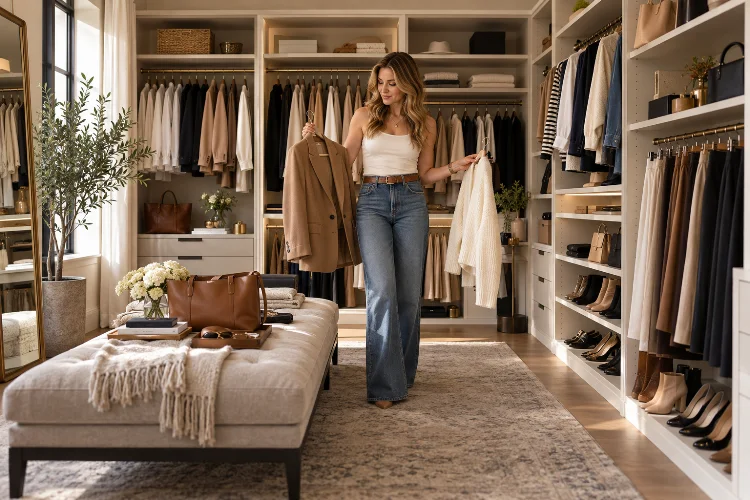
A wardrobe can contain plenty of good clothes and still feel strangely difficult to use. You open the closet, see dozens of options, and somehow conclude that nothing works together.
Usually, the problem is not a lack of clothing. It is a lack of connection between the clothes, your lifestyle, and the person you want them to represent.
Building a cohesive wardrobe around lifestyle and identity means creating a collection where colors, silhouettes, fabrics, levels of formality, and individual pieces work together while still feeling personal.
Clothing is more than practical covering; research shows that dress contributes to self-presentation and can influence the impressions others form about identity, status, and aesthetic preferences.
The goal is not a perfectly coordinated minimalist closet. It is a wardrobe that makes sense.
When the pieces support your actual activities and share a recognizable visual language, getting dressed becomes faster, shopping becomes more intentional, and your personal style becomes easier to maintain.
1. Start With the Life You Actually Live
Before choosing colors or creating a shopping list, look honestly at how you spend your week.
Someone working in a formal office needs a different wardrobe balance from someone working remotely, studying, traveling frequently, or spending most days in a creative environment.
A useful wardrobe reflects those proportions.
If 70% of your life is casual but most of your closet consists of special-event clothing, you may own beautiful pieces while constantly feeling underprepared for ordinary days.
Write down the major situations you regularly dress for: work, weekends, exercise, social events, religious or cultural occasions, travel, and formal commitments.
You do not need equal quantities for every category.
Your most common activities should receive the most wardrobe space. This simple shift prevents you from shopping primarily for an imaginary version of your lifestyle.
2. Define the Identity Behind Your Clothes
Lifestyle tells you what clothes need to do. Identity helps determine what they should feel like.
Choose three to five words describing how you want your style to come across.
You might choose relaxed, modern, polished, understated, and creative. Another person might choose classic, strong, minimal, and refined.
These words act as filters.
Research on daily dress has found that self-presentational motives play a role in why people choose particular clothing, while studies of personal clothing style connect dress with self-concept, consistency, comfort, and expressions of the actual or ideal self.
That does not mean clothing should become a performance.
The strongest identity usually comes from reinforcing qualities you already like rather than inventing a completely different character.
When considering a new item, ask whether it supports your style words.
If not, it may be attractive without actually belonging in your wardrobe.
3. Create a Flexible Color System
Cohesion becomes dramatically easier when most of your colors can communicate with each other.
Start with several dependable neutrals.
For example, your foundation might be navy, cream, charcoal, denim blue, and brown. Another wardrobe might revolve around black, white, olive, grey, and camel.
Then introduce a smaller number of accent colors.
Burgundy, cobalt, forest green, dusty pink, or burnt orange can create personality without making combinations difficult.
You do not have to follow rigid color theory.
The real test is whether the colors you own actually combine easily.
Think in combinations, not individual colors
A bright green jacket may look fantastic by itself.
But if it works with only one pair of trousers in your entire wardrobe, its practical value is limited.
Before buying a new color, imagine at least three outfits you can create using pieces you already own.
That habit gradually builds visual consistancy while still leaving room for experimentation.
4. Identify Your Best Silhouettes
A cohesive wardrobe does not require every garment to have exactly the same shape.
It does benefit from a few recurring silhouettes.
Perhaps you consistently prefer straight trousers with relaxed shirts. Maybe fitted tops with wide-leg bottoms feel more natural. You might rely heavily on structured jackets, long outerwear, cropped layers, or loose tailoring.
Look through photographs of outfits you genuinely enjoyed.
Patterns usually emerge quickly.
Fit matters here because clothing that works technically but feels wrong on your body rarely becomes a dependable wardrobe staple.
Research involving more than 500 fashion consumers found relationships between clothing fit, self-evaluation, confident clothing decisions, and psychological responses.
Instead of forcing yourself into every new silhouette, identify the proportions that repeatedly make you feel comfortable and visually balanced.
Those become the foundation.
5. Build Outfit Formulas Around Daily Needs
Once you know your lifestyle and preferred silhouettes, turn them into repeatable outfit formulas.
A formula might be:
Straight trousers + simple knit + structured jacket + loafers
Another could be:
Relaxed jeans + fitted T-shirt + overshirt + clean sneakers
You are not creating a uniform.
You are creating a reliable structure that can be varied through color, fabric, accessories, and individual garments.
This is especially helpful when mornings are busy.
Instead of designing an outfit from zero every day, you already understand which combinations work.
It also makes shopping easier. A new garment should ideally fit into an existing formula or create a clearly useful new one.
If you cannot imagine how you would wear something with your current closet, attraction alone may not justify the purchase.
6. Make Lifestyle Compatibility Part of Quality
People often define clothing quality only through materials, stitching, or brand reputation.
Practical compatibility matters just as much.
A beautiful silk blouse that requires difficult care may not be particularly useful if your schedule demands easy washing and frequent wear.
Heavy tailoring may look impressive but become irrelevant if you live somewhere hot and spend most of your day casually dressed.
Quality should include how well an item performs in your life.
Consider climate, movement, washing requirements, footwear needs, transportation, and how often you realistically expect to wear it.
A garment becomes more valuable when it is easy to integrate and maintain.
Research into sustainable clothing use emphasizes that the post-purchase stage – including wearing, caring for, and repairing clothes – is important to garment longevity.
Buying well is only the beginning.
Using well matters too.
7. Allow Repetition Instead of Constant Novelty
A cohesive wardrobe naturally repeats ideas.
You may discover that you own several versions of the same trouser shape, multiple plain shirts, or three jackets with similar proportions.
That is not automatically redundant.
If those items are regularly worn, repetition may simply mean you have identified what works.
Signature style is built partly through recurring visual choices.
Studies of dress and person perception suggest that people draw information from clothing about social identity, aesthetics, and other characteristics, although meanings remain highly dependent on context and culture.
Consistency therefore helps your image become recognizable.
The goal is not to avoid variety. It is to create variety inside a clear framework.
You can change fabrics, accessories, textures, and accent colors while keeping your overall language familiar.
8. Use the Capsule Wardrobe Idea Without Following a Number
Capsule wardrobes can provide useful inspiration, but you do not need an arbitrary limit such as 30 or 40 pieces.
Your lifestyle may genuinely require more.
The valuable principle behind a capsule system is intentional compatibility: a higher percentage of garments should work with several other pieces.
Recent research into capsule wardrobe adoption has explored how people balance durability, quality, price, environmental concerns, emotional attachment, and practical constraints when creating more deliberate wardrobes.
Use that idea flexibly.
Instead of counting every garment, measure usefulness.
If you own 70 pieces but regularly wear and combine most of them, your wardrobe may be far more cohesive than a 30-piece closet containing items that barely work together.
Function is more important than the number.
9. Shop to Fill Gaps, Not to Create New Ones
One of the biggest differences between a cohesive wardrobe and a chaotic one is how new clothes enter it.
Chaotic wardrobes are often built through isolated purchases.
Cohesive wardrobes grow through gaps.
Maybe you already own several good trousers and shirts but have no versatile outer layer. That becomes a useful shopping priority.
Perhaps most of your clothes work together except your footwear. Solve that problem before buying another top.
Before purchasing, ask three questions: where will I wear this, what does it work with, and what role does it fill?
If the answer to all three is vague, you may be creating another wardrobe orphan.
Intentional purchasing also helps reduce the cycle of constantly buying something new while still feeling like nothing matches.
10. Audit Your Wardrobe Through Real Outfits
Do not evaluate your wardrobe only by looking at clothes on hangers.
Test it through actual outfits.
Photograph what you wear for several weeks. Notice which combinations you repeat, which garments always require effort, and which items rarely leave the closet.
You may discover that you consistently rely on certain colors or shapes.
That information is valuable.
It tells you what your personal style already is rather than what you think it should be.
You may also notice pieces that represent an older identity or lifestyle.
There is nothing wrong with letting those go when they are no longer useful.
Wardrobe cohesion improves when the closet reflects who you are now, not every version of yourself you have ever been.
Building a cohesive wardrobe around lifestyle and identity starts with understanding your life before buying more clothes.
Map your real activities, define the qualities you want your appearance to communicate, and build around compatible colors, dependable silhouettes, and repeatable outfit formulas.
Prioritize fit and practicality, then let strong ideas repeat rather than constantly searching for novelty.
A cohesive wardrobe should also evolve as your lifestyle changes.
Start by reviewing what you wore during the past month. Identify your most-used pieces, strongest combinations, and obvious wardrobe gaps before your next shopping trip.
When every purchase has a clear role and most garments work together, getting dressed becomes considerably easier – and your personal style becomes more recognisable without requiring a bigger closet.