
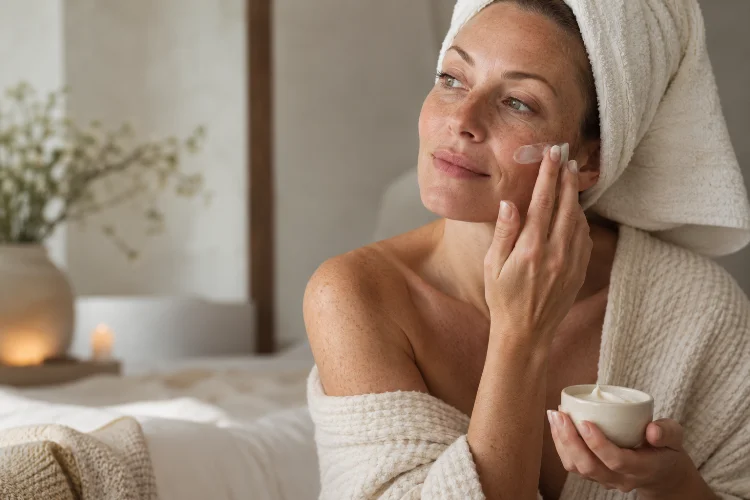
Skin does not need to be visibly peeling or inflamed to be under stress. Sometimes the first clues are more subtle: your face feels unusually tight after cleansing, moisturizer disappears within minutes, or a product you normally tolerate suddenly starts to sting.
When that happens, the skin barrier may be having a harder time doing its job.
One of the most important components of that barrier is ceramides. These naturally occurring lipids sit within the stratum corneum, the outermost layer of the skin, where they help create a water-resistant matrix around skin cells.
Ceramides account for roughly half of the lipid content of this barrier by weight, alongside cholesterol and free fatty acids.
Understanding how ceramides support barrier recovery in stressed skin types can make skincare much less confusing.
Rather than simply adding more hydration, ceramide-focused care aims to support the structure that helps skin hold onto water, tolerate everyday stress, and recover more efficiently.
1. Ceramides Are a Structural Part of the Skin Barrier
The stratum corneum is often described using the “bricks and mortar” model.
Corneocytes, or mature skin cells, act like bricks. The lipid matrix surrounding them acts like mortar, helping seal the spaces between cells.
Ceramides make up a major part of that lipid matrix, together with cholesterol and free fatty acids.
These lipids organize themselves into highly ordered layers that slow water from escaping through the epidermis and limit the penetration of unwanted substances from the environment.
This is why ceramides are not simply moisturizing ingredients in the traditional sense.
They contribute to the physical architecture of the barrier itself.
When that architecture is working properly, the skin generally retains moisture more efficiently and handles normal environmental exposure with less difficulty.
2. Stressed Skin Can Lose Water More Easily
Healthy-looking skin constantly loses a small amount of water through a process known as transepidermal water loss, or TEWL.
That is normal.
Problems arise when the barrier becomes disrupted and water begins escaping more easily than it should. Dry air, aggressive cleansing, excessive exfoliation, retinoids, repeated friction, and certain inflammatory skin conditions can all influence barrier function.
In people with atopic dermatitis, for example, studies have found reduced or altered ceramide levels in the stratum corneum alongside increased water loss and impaired hydration.
That does not mean every person with dry or sensitive skin has atopic dermatitis.
It simply illustrates how important lipid composition is to barrier performance.
If your skin is temporarily stressed by strong actives or enviromental conditions, supporting its lipid layer can make more sense than repeatedly adding lightweight hydrating serums without addressing moisture retention.
3. Ceramides Help Skin Hold Onto Hydration
Hydration and moisturization are closely related, but they are not exactly the same thing.
You can put plenty of water-attracting ingredients on the skin and still experience dryness if the barrier cannot retain that moisture effectively.
This is where ceramides become especially useful.
Because they contribute to the extracellular lipid matrix, they help create the hydrophobic structure that limits excessive water movement through the stratum corneum.
Reviews of skin barrier biology consistently identify ceramides as essential components of epidermal permeability and moisture retention.
Ceramides work best as part of a system
This is also why a good moisturizer often contains more than one type of ingredient.
Humectants such as glycerin can help attract water. Occlusive ingredients can reduce evaporation. Emollients smooth the skin surface, while physiologic lipids such as ceramides can support the barrier matrix.
The combination is often more useful than expecting one fashionable ingredient to solve everything.
4. Not All Ceramide Deficiency Looks the Same
It is tempting to think of ceramides as one single substance, but skin biology is far more complicated.
There are multiple ceramide classes with different fatty-acid chain lengths and molecular structures. The balance among those species influences how tightly the lipid matrix can organize itself.
Recent research into atopic dermatitis has found not only lower overall ceramide levels in some patients but also altered ceramide distribution and a shift toward shorter-chain lipid structures.
Those changes are associated with reduced barrier efficiency and greater water loss.
This helps explain why skincare formulation matters.
A product does not automatically become an excellent barrier treatment simply because the word “ceramide” appears on the label.
The concentration, supporting ingredients, delivery system, and overall formula all influence how useful that moisturizer may be.
5. Ceramide Moisturizers Can Support Barrier Recovery
Ceramide-containing moisturizers have been studied most extensively in people with dry and barrier-impaired skin, especially atopic dermatitis.
A 2023 systematic review and meta-analysis found that ceramide-containing moisturizers improved clinical measures and TEWL, although their reduction in TEWL was not statistically superior to other moisturizers included in the analysis.
Clinical severity scores showed a greater improvement with ceramide-containing products.
That distinction is important.
Ceramides can be helpful, but they are not automatically superior to every well-formulated moisturizer.
Another study involving people with controlled atopic dermatitis found that a moisturizer containing a ceramide precursor improved hydration, dryness, and TEWL after four weeks compared with untreated skin.
The practical takeaway is not that everyone needs an expensive ceramide cream.
It is that ceramides are biologically relevant ingredients that may help support a compromised lipid barrier when incorporated into an effective moisturizer.
6. Ceramides Are Especially Useful When Skin Is Overworked
Modern skincare routines can become surprisingly demanding.
A person might use retinoids several nights per week, exfoliating acids on alternate days, vitamin C every morning, acne treatments, double cleansing, and occasional scrubs.
Individually, some of these products may be perfectly appropriate. Together, however, they can create more irritation than the skin can comfortably recover from.
When this happens, a ceramide moisturizer may be useful as part of a simpler recovery routine.
Instead of layering five “repair” products, consider reducing unnecessary actives while keeping cleansing gentle and moisturization consistant.
This approach supports natural recovery without creating another overloaded routine.
Ceramides do not cancel out aggressive skincare. They work better when the source of repeated irritation is also addressed.
7. Look for the Whole Formula, Not Just the Ceramide Label
When choosing a moisturizer for stressed skin, the complete formula matters more than one highlighted ingredient.
Ceramides may be combined with cholesterol, fatty acids, glycerin, petrolatum, dimethicone, hyaluronic acid, or other barrier-supporting ingredients. These components can perform different but complementary roles.
Research into ceramide-based moisturizers also suggests that lipid ratios, structure, concentration, and delivery methods can influence performance.
Texture matters too.
A lightweight lotion may be comfortable for mildly dehydrated or humid-climate skin, while a richer cream may be more suitable for pronounced dryness or frequent exposure to air conditioning.
The American Academy of Dermatology notes that moisturizers containing ingredients such as ceramides and glycerol can be part of treatment for excessively dry skin.
The best product is ultimately one that your skin tolerates and that you can use regularily.
8. Give Barrier Recovery Enough Time
Barrier repair is not usually an overnight process.
A moisturizer may improve surface comfort quickly, but structural recovery takes time, especially if irritation has been building for weeks.
One useful strategy is to temporarily simplify your routine. Use a gentle cleanser, a barrier-supportive moisturizer, and appropriate sun protection while reducing nonessential irritating products.
Once your skin feels comfortable again, treatments can be reintroduced seperately and gradually.
Watch for practical signs of progress: less tightness after cleansing, reduced stinging, smoother texture, less flaking, and improved tolerance to your normal routine.
Persistent redness, itching, painful cracking, or recurrent rashes should not automatically be treated as simple “barrier damage.” Those symptoms can have several causes and may benefit from evaluation by a dermatologist.
Ceramides play a fundamental role in keeping the skin barrier organized, hydrated, and resistant to everyday stress.
By helping form the lipid matrix of the stratum corneum, they reduce unnecessary water loss and support the structure that separates the body from the outside environment.
For stressed skin, ceramide-containing moisturizers can be a useful part of recovery, especially when combined with gentle cleansing and fewer unnecessary irritants.
The key is not to chase the product with the biggest ceramide claim. Look at the entire formula, use it consistantly, and give your skin enough time to recover.
If your routine has recently become uncomfortable, start by simplifying it. A calmer routine and a well-formulated moisturizer may do more for barrier maintainance than adding another strong active.